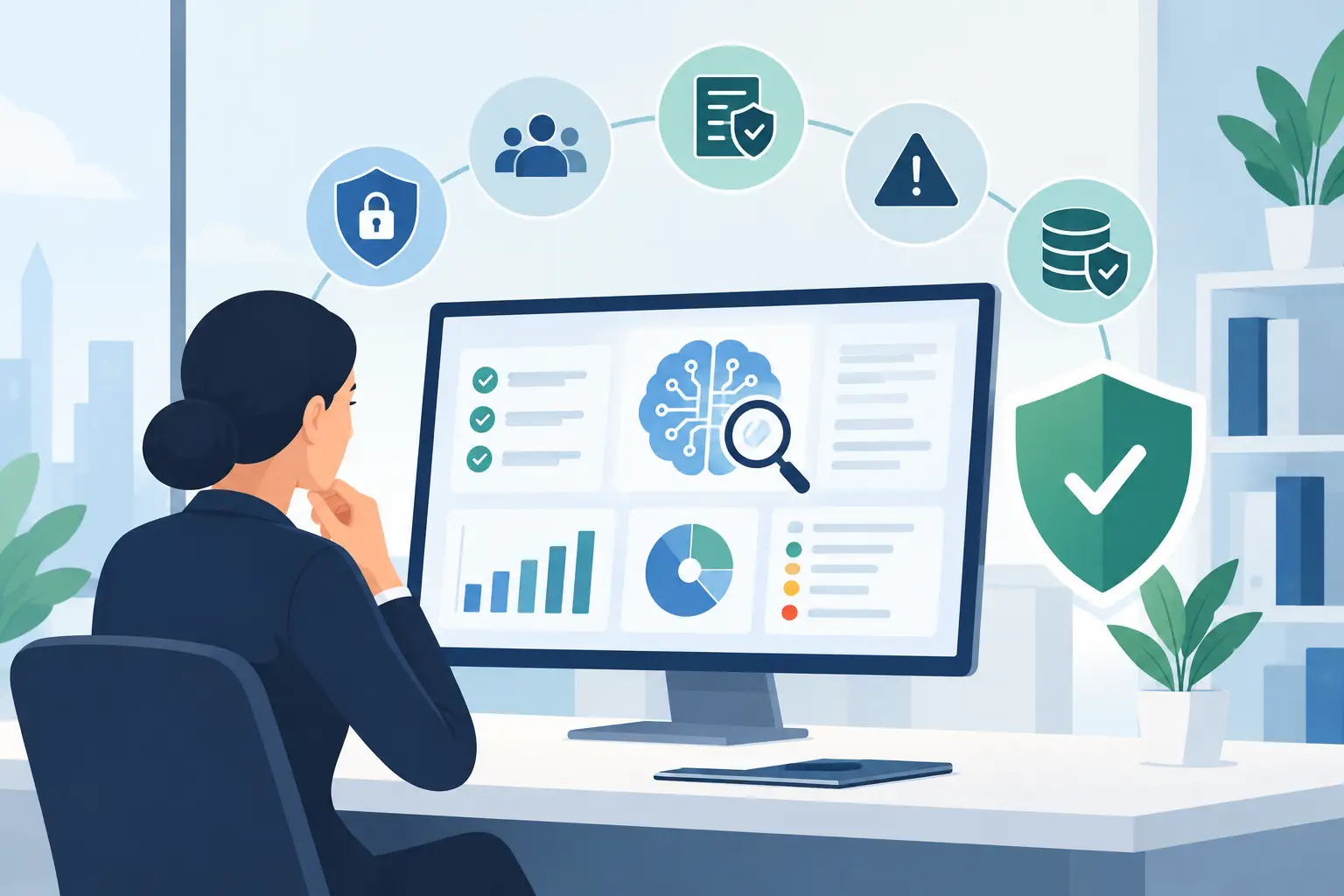
A team can begin using a generative AI tool in an afternoon. A few months later, that same organization may struggle to answer basic questions: Which tools are being used? What company or customer data enters them? Who approved their use? What happens when an AI-generated output affects a customer, employee, or business decision?
AI audit tools help turn those unknowns into a structured view of risk. For business leaders, they are not simply another compliance exercise. They create a practical starting point for understanding where AI is used, where controls are missing, and which actions deserve attention first.
The value is not in producing a score for its own sake. A useful assessment gives leaders evidence they can discuss with legal, security, compliance, operations, and AI owners. It replaces broad concern with a documented basis for oversight.
What AI Audit Tools Should Assess
AI auditing is sometimes confused with testing whether a model is technically accurate. Technical testing matters, especially for high-impact systems, but governance has a wider scope. The organization also needs to understand how a system was selected, what data it handles, who is accountable for it, and whether people retain appropriate authority over consequential decisions.
Effective AI audit tools examine both the technology and the operating environment around it. They should help an organization identify AI systems in use, including employee-led use of public tools, vendor platforms with embedded AI, and internally developed applications. An inventory that only covers formally purchased software will miss a significant portion of real-world exposure.
The assessment should also consider the nature of each use case. An AI tool used to summarize internal meeting notes presents different concerns than one used to screen job applicants, recommend loan terms, generate customer communications, or support clinical decisions. Risk depends on the system's purpose, the people affected, the data involved, and the consequences if the output is wrong, biased, insecure, or used without review.
Governance questions are equally important. Does the organization have a defined owner for each meaningful AI use case? Are employees clear about approved and prohibited uses? Has the vendor's security and data handling approach been reviewed? Is there a process for reporting a problem, escalating an issue, or discontinuing a tool when conditions change?
A credible audit process does not assume every organization needs the same controls. It helps leaders distinguish between low-risk experimentation and AI use that requires stronger documentation, review, human oversight, and ongoing monitoring.
Why an AI Inventory Alone Is Not Enough
Many organizations begin responsibly by creating a spreadsheet of AI tools. That is useful, but it is only the first layer. A list tells you what may be present. It does not show whether the business has assessed the associated risks or assigned accountability.
Consider a customer-support platform that introduces an AI drafting feature. The inventory can capture the platform name. A governance review asks the harder questions: Are support representatives required to verify outputs before sending them? Can the feature access customer records? Is sensitive information retained by the provider? Can customers understand when they are interacting with AI-assisted content? Who is responsible for reviewing performance and incidents over time?
Those questions are what make an AI audit operationally useful. They connect technology adoption to existing security, privacy, legal, procurement, and risk-management responsibilities.
This distinction also matters when leaders need to communicate with boards, customers, regulators, or business partners. Saying that the company is "aware of AI" is not the same as showing that it has a repeatable method to identify exposure, assess controls, document decisions, and address gaps.
What a Useful AI Audit Produces
The best AI audit tools do more than collect answers. They organize information into a result that decision-makers can use. A professional report should clarify the organization's current posture without overstating certainty or implying that a short assessment can guarantee compliance.
At a minimum, the output should help answer five practical questions:
- Where is AI currently used, planned, or likely to be adopted without formal review?
- Which uses create the highest concerns for privacy, security, fairness, transparency, or human oversight?
- What policies, ownership structures, and review processes already exist?
- Where are the most material control gaps?
- What actions should be prioritized next, based on the organization's risk profile?
The report should be understandable to executives without losing value for specialists. Security leaders need enough detail to connect findings to vendor review and data controls. Legal and compliance teams need a basis for evaluating obligations and documentation. Operations leaders need clear ownership and workable next steps. A result that is too technical for leaders or too vague for practitioners will not move the organization forward.
Speed matters here, but only when it supports quality. A short, structured checkup can give an organization a credible baseline quickly. It is particularly valuable when AI use has expanded faster than internal governance processes. Alignora's free AI Risk Checkup is designed for this moment, helping organizations identify risk exposures and generate a professional governance report in approximately five minutes.
Choosing AI Audit Tools for the Right Need
There is no single category of AI audit tool that solves every governance challenge. The right approach depends on the organization's maturity, the kinds of AI it uses, and the stakes involved.
A structured risk assessment is often the right first step for a business that needs visibility and a documented baseline. It can reveal missing policies, unclear ownership, unreviewed vendors, and gaps in oversight before they become harder to address. This is especially useful for organizations adopting generative AI across several functions or preparing to formalize an AI governance program.
Technical evaluation tools serve a different purpose. They may test model quality, bias, security vulnerabilities, prompt injection exposure, drift, or output behavior. These capabilities can be essential for organizations building models, deploying high-impact AI, or operating systems where failures can materially affect people or business outcomes. However, technical testing alone will not establish a governance structure.
Continuous monitoring may be appropriate once AI use is mature, widespread, or subject to meaningful change. It requires more investment and operating discipline, but it can help organizations track systems, approvals, performance, incidents, and control status over time. For many businesses, beginning with a clear assessment and then expanding controls is more realistic than attempting to build a full monitoring program immediately.
The key is to avoid treating a tool purchase as the governance program itself. Technology can structure evidence and surface gaps, but management must still make decisions, assign owners, and follow through.
Turn Findings Into Action
An assessment has limited value if it ends as a PDF in a shared drive. The next step is to assign an accountable owner for the findings and agree on a small number of priority actions. In most organizations, that starts with the highest-risk or least-understood uses rather than trying to fix every issue at once.
A sensible first phase may include establishing an approved-use policy, creating an AI inventory, assigning owners for significant systems, and adding AI questions to vendor review. It may also mean defining when human review is required and what employees should do when an AI tool produces an inaccurate, harmful, or unexpected result.
The second phase should connect AI governance to processes the organization already uses. Procurement can require AI-related vendor information. Security review can address data access and retention. Privacy review can assess personal information. Legal can evaluate contracts, disclosures, and sector-specific obligations. Human resources can address employee use and training. This approach makes governance part of normal business operations rather than a separate initiative that fades after launch.
Documentation should evolve as systems and uses change. An AI tool that is initially approved for drafting internal content may later be connected to customer data or used in a customer-facing workflow. That change may alter its risk profile and require a new review. Regular reassessment is not bureaucracy for its own sake. It is how oversight keeps pace with adoption.
Human Accountability Remains the Control That Matters
AI audit tools can accelerate visibility, organize evidence, and provide a disciplined framework for risk decisions. They cannot decide what level of risk your organization is willing to accept, nor can they replace accountable judgment when an AI system affects people or critical business outcomes.
The most useful next move is often a simple one: establish a documented baseline before AI use becomes too dispersed to manage confidently. From there, leaders can make deliberate choices about where to encourage innovation, where to add safeguards, and where human review must remain firmly in control.