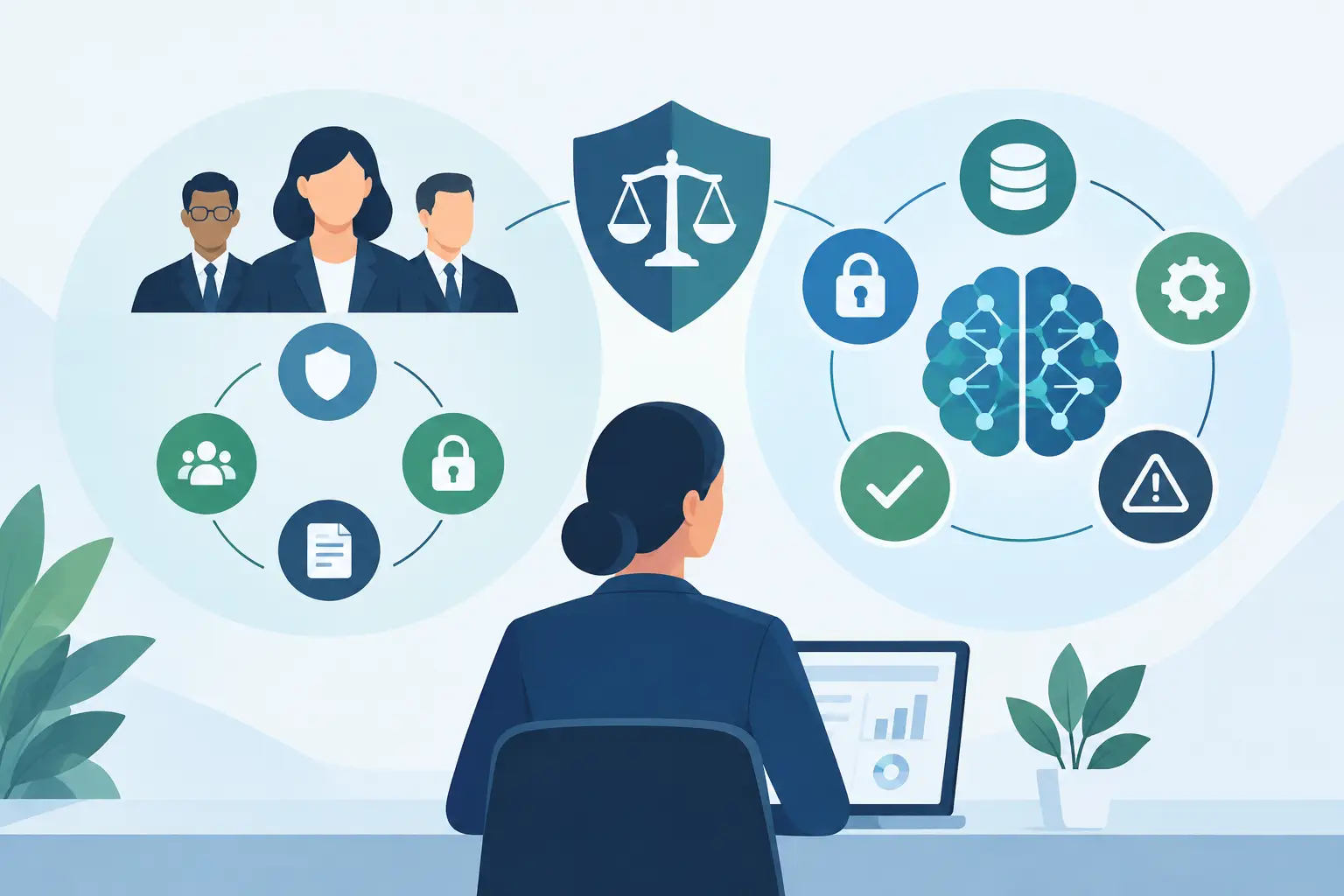
A model can pass validation and still create a business problem. It may produce accurate outputs while exposing customer data through an unapproved tool, influencing a high-impact decision without human review, or operating with no documented owner. That is the practical difference behind AI governance versus model governance: one governs the organization’s use of AI, while the other governs the lifecycle and performance of individual models.
For leaders under pressure to adopt AI quickly, treating these disciplines as interchangeable creates blind spots. Model controls are necessary, but they do not answer every question a legal, compliance, security, or business leader needs to ask. A clear distinction helps organizations move from scattered AI experiments to accountable, documented oversight.
AI Governance Versus Model Governance: The Core Difference
Model governance focuses on the model itself. It asks whether a particular model is fit for purpose, performs as expected, is properly tested, and continues to operate within acceptable limits. This discipline has deep roots in financial services, where organizations have long managed models used for credit, fraud, pricing, forecasting, and capital planning.
AI governance has a wider scope. It establishes how the organization decides where AI may be used, who is accountable, what risks require review, which safeguards apply, and how leaders can demonstrate oversight. It includes models, but it also covers generative AI tools, vendors, data practices, employee use, decision rights, policies, and incident response.
Put simply, model governance asks, “Can we trust this model for this use?” AI governance asks, “Should we use AI this way, under whose authority, with what controls, and how will we remain accountable?”
Neither discipline replaces the other. The right balance depends on your AI footprint. A company using a few employee-facing generative AI tools may need stronger organization-wide policies and vendor controls before it needs detailed model performance testing. A company developing or deploying models for lending, hiring, healthcare, insurance, or other consequential decisions will need both disciplines in depth.
What Model Governance Covers
A model governance program creates disciplined controls around the design, validation, deployment, monitoring, and retirement of a model. The objective is not to guarantee perfection. It is to understand limitations, set acceptable performance thresholds, and detect when the model no longer performs as intended.
Performance, validation, and drift
Before deployment, a model should be assessed against its intended use case. Teams may evaluate accuracy, reliability, error rates, explainability, bias, and resilience to unusual inputs. Independent validation is especially valuable when the model informs material business decisions or affects individuals.
After deployment, monitoring matters just as much. Data changes, user behavior shifts, and business conditions evolve. A model that performed well six months ago may begin producing weaker or less reliable results. Model governance defines what teams monitor, how often they review it, and what triggers remediation or suspension.
Documentation and traceability
A governed model has an understandable record. That record typically describes its purpose, inputs, development approach, assumptions, known limitations, validation results, approval status, and ownership. Documentation gives reviewers a basis for challenge and gives leaders evidence that the model was not deployed without scrutiny.
For generative AI, traceability can be more complicated. Organizations may rely on third-party foundation models, changing provider capabilities, prompts, retrieval systems, fine-tuning, and connected business data. The governance question remains the same: can the organization explain what the system is doing, where its information comes from, and who is responsible for its operation?
Change management
A model is rarely static. Retraining, feature changes, new data sources, prompt updates, or vendor releases can alter its behavior. Model governance establishes when a change requires testing, reapproval, or expanded monitoring.
This is a common point of failure with generative AI. A team may view a prompt change or a new integration as a minor operational update, even though it expands the data exposed to the system or changes how outputs reach customers. The level of review should match the significance of the change.
What AI Governance Covers Beyond the Model
AI governance brings model-level controls into a business-wide operating framework. It connects technical activity to organizational accountability, risk appetite, legal obligations, privacy expectations, and security requirements.
Use-case approval and risk classification
Not every AI use case carries the same level of risk. Internal brainstorming support and automated candidate screening should not face identical oversight. AI governance provides a consistent way to classify use cases based on factors such as decision impact, data sensitivity, autonomy, customer exposure, regulatory relevance, and third-party dependency.
That classification should lead to practical requirements. A lower-risk use case may require basic disclosure, approved-tool use, and employee guidance. A higher-risk use case may require formal review, documented testing, human approval before action, legal assessment, and ongoing monitoring.
Accountability across functions
The model owner is not always the person accountable for AI risk. A business leader may own the outcome, an information-security team may assess access and threats, privacy may review data handling, legal may evaluate obligations, and compliance or risk may set the review process.
AI governance makes these roles visible. It defines who can approve a use case, who can challenge it, who monitors it after launch, and who has authority to pause it. Without those decisions, organizations often discover that everyone assumed someone else was overseeing the risk.
Data, security, and vendor oversight
Many organizations are adopting AI through third-party tools rather than building models in-house. In those cases, model-level information may be limited. The organization still needs to assess the provider’s data practices, security controls, contractual commitments, model-update process, retention terms, and incident-notification approach.
AI governance also addresses employee behavior. Are teams entering confidential information into public tools? Are approved enterprise tools configured to protect business data? Are employees relying on AI output without checking it? These are organizational control questions, not merely model questions.
Transparency, human oversight, and response plans
When AI influences people, customers, or material operations, leaders need clarity about disclosure and human involvement. The appropriate approach depends on the use case. A drafting assistant may need clear usage guidance. An AI system that recommends employment, financial, medical, or eligibility decisions may require stronger human review, escalation paths, and documented rationale.
AI governance also prepares the organization for failure. A useful program defines how concerns are reported, who investigates, how affected systems are contained, and how lessons are incorporated into future assessments. Good governance does not assume incidents will never occur. It ensures the organization can respond with judgment and evidence when they do.
Where Organizations Commonly Draw the Line Wrong
The first mistake is building a model inventory and calling it AI governance. An inventory is a valuable starting point, but it does not establish decision rights, risk tiers, approved-use rules, or accountability for third-party tools.
The second is creating an AI policy with no operational process behind it. A policy that says employees must use AI responsibly is not enough if there is no review path, no owner, and no record of what tools or use cases exist. Governance becomes credible when it changes how decisions are made.
The third is applying the same controls everywhere. Overly burdensome reviews encourage shadow AI use, especially when employees see approved processes as too slow for ordinary work. The answer is not less oversight. It is proportionate oversight that reserves deeper review for higher-risk uses.
Building a Connected Governance Approach
Start with visibility. Identify AI tools, models, vendors, and use cases already in operation, including informal use within business functions. Then establish a simple risk classification that gives teams a practical route for requesting approval or raising concerns.
Next, assign accountable owners. Each significant AI use case should have a business owner, while central functions define standards and challenge risk decisions. For internally developed or high-impact models, connect this process to model validation, performance monitoring, and change controls.
Finally, create evidence as you go. Keep records of assessments, approvals, limitations, required safeguards, monitoring activities, and material incidents. Documentation is not paperwork for its own sake. It allows leadership to see where risk is concentrated and demonstrate that AI adoption is being managed deliberately.
A structured diagnostic can help establish that baseline quickly. Alignora’s free AI Risk Checkup is designed to help organizations identify relevant AI risk exposures and produce a professional governance report that supports the next conversation with leadership, legal, security, and operational teams.
The useful question is not whether your organization needs AI governance or model governance. It is where each should begin, who should own it, and what evidence will help your people use AI with appropriate judgment and accountability.