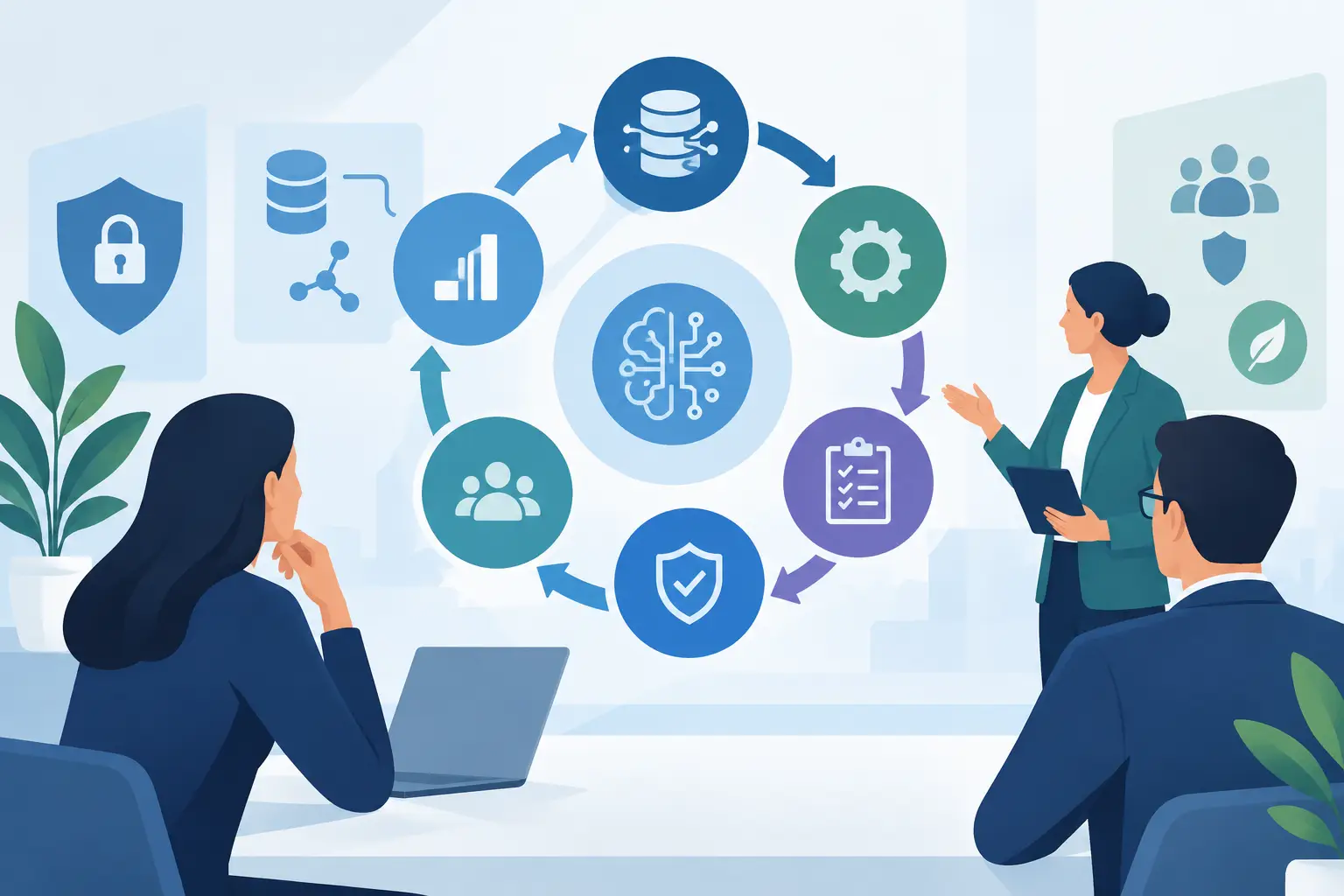
A model can produce a useful answer in a pilot and still create a serious business problem six months later. Data changes, employees find new uses, vendors update capabilities, and a once-low-risk tool begins influencing customer, hiring, financial, or operational decisions. An effective AI model lifecycle guide gives leaders a way to manage those changes before they become incidents.
The lifecycle is not only a technical sequence from development to deployment. It is a governance process that establishes why an AI system exists, who is accountable for it, what risks it creates, and when it must be reviewed, changed, or retired. That process should work for internally built models, third-party AI software, generative AI tools, and automated decision systems.
What an AI Model Lifecycle Guide Should Cover
A useful lifecycle framework follows the system from its first business proposal through retirement. The level of control should match the system's impact. A team using an approved generative AI assistant to summarize internal notes does not need the same review process as a model that helps prioritize job applicants or detect fraud.
What should remain consistent is evidence. For every meaningful AI use, the organization should be able to explain the business purpose, the data involved, the owner, the affected people, the key controls, and the current risk status. This record gives executives, legal teams, security leaders, and operators a shared basis for decisions.
Lifecycle governance also prevents a common failure: treating model approval as a one-time event. Approval is a decision based on the system's known use and risk at a specific point in time. It is not a permanent guarantee that the system will remain appropriate.
1. Start With a Defined Business Purpose
The strongest governance work begins before a tool is purchased or a model is trained. The requesting team should describe the business problem, expected value, intended users, and the decisions the system will support or influence. Vague goals such as "use AI to improve efficiency" are difficult to assess and even harder to monitor.
Clarify whether the system will generate content, make predictions, recommend actions, rank people or options, or automate a decision. These functions carry different risks. A drafting assistant may create confidentiality and accuracy concerns. A ranking model may introduce fairness, explainability, and contestability concerns, especially when people are affected.
At this stage, assign a business owner who is accountable for outcomes and a technical or operational owner who understands how the system is configured and used. Governance cannot sit solely with IT, legal, or compliance. Those teams provide essential challenge and oversight, but the business owner must remain responsible for the purpose and use of the system.
2. Assess Risk Before the System Expands
Risk assessment should happen before deployment, not after employees have integrated the tool into daily work. Review the data entering the system, the outputs it produces, the people affected, and the consequences of an incorrect, biased, insecure, or misleading result.
For third-party AI, evaluate the vendor as well as the product. Ask how data is handled, whether customer inputs may be retained or used for training, how access is controlled, what security commitments apply, and how material product changes are communicated. A vendor's name recognition does not remove the need for review.
For internally developed models, assess data quality, data provenance, training and testing practices, performance boundaries, and the possibility of misuse. A model can meet a performance target while still creating unacceptable risk for a particular population, workflow, or decision type.
The assessment should lead to a practical risk decision. The system may be approved with standard controls, approved with additional safeguards, limited to a pilot, held for remediation, or declined. The decision and its rationale should be documented. That record is valuable when leaders need to demonstrate that AI adoption was considered, not improvised.
3. Build Controls Into Design and Procurement
Controls work best when they are established before users depend on the system. Requirements may include role-based access, approved data sources, prompt and output handling rules, human review steps, logging, retention limits, and employee training. The right mix depends on the use case and risk level.
Human oversight deserves particular attention. It should be meaningful, not symbolic. If an employee is expected to review an AI recommendation, they need enough context, authority, and time to challenge it. A reviewer who is expected to approve hundreds of recommendations per hour is not providing effective oversight.
For systems that affect customers, employees, or other individuals, teams should also consider disclosure and escalation processes. People may need to know when AI plays a material role, how to seek help, and how to challenge an outcome. The exact approach depends on the use case, applicable obligations, and the potential impact of an error.
Procurement is a key control point because software can enter the organization faster than governance processes can catch it. Establish a clear path for teams to request and assess AI-enabled vendors. If the path is too slow or confusing, employees may use unapproved tools instead, creating shadow AI and reducing visibility.
4. Validate Before Deployment
Validation asks a direct question: does the system perform acceptably for the intended use under realistic conditions? Technical testing matters, but it is only part of the answer. A model should also be tested for harmful outputs, inconsistent behavior, security weaknesses, privacy exposure, and failure modes that may not appear in standard performance metrics.
Testing should reflect the real environment. A model tested on clean historical data may behave differently when users enter incomplete information, unusual requests, or adversarial prompts. Generative AI requires special attention because responses can vary from one interaction to the next.
Document the test scope, results, known limitations, and any conditions placed on release. If a system is not reliable enough to act independently, it may still be useful as a decision-support tool with clear human review. That is often a sensible trade-off, provided users understand the limitation and the workflow supports intervention.
5. Monitor the Model in Production
Deployment is the point where governance becomes operational. The organization should monitor whether the system is being used as intended, whether performance remains acceptable, and whether new risks have appeared. Monitoring is especially important when data patterns, user behavior, or vendor capabilities change.
The monitoring plan should identify meaningful signals for the use case. These may include error rates, output quality, override rates, user complaints, security events, fairness indicators, or unexpected changes in usage. A sudden rise in overrides may show that users no longer trust recommendations. A decline in usage may indicate the tool is not delivering value or that teams have found unapproved alternatives.
Set review intervals based on risk, not convenience. Higher-impact systems may require frequent operational review and formal periodic reassessment. Lower-risk tools may need lighter checks, but they should still be revisited when their purpose, data, integrations, or user base changes.
Create clear triggers for escalation. An incident, a material vendor update, a new regulatory requirement, evidence of harmful output, or a proposed expansion into a higher-impact workflow should prompt a new review. The goal is not to stop innovation. It is to ensure that a system is not quietly repurposed beyond the conditions under which it was approved.
6. Manage Change, Then Retire Responsibly
AI systems change more often than many organizations expect. A vendor may replace an underlying model, add new data-processing options, alter retention practices, or introduce agent-like features that can take action in connected business systems. Internal teams may change prompts, retrain models, add data sources, or expand access. Each significant change can alter the risk profile.
Define what counts as a material change and who must review it. For example, a new user group or a connection to sensitive data may require governance approval even if the core product remains the same. Change control does not have to be bureaucratic, but it must be visible and proportionate.
Retirement is equally important. When an AI system is no longer needed, remove access, end integrations, archive required records, address data retention, and communicate the change to users. If the system influenced decisions or produced records that must be retained, preserve them according to organizational policy and legal requirements.
Turn Lifecycle Evidence Into Action
A mature program does not need to begin with a large governance office or a complex technical platform. It needs a consistent way to identify AI use, assess exposure, assign ownership, and document decisions. From there, controls can become more detailed as adoption and risk increase.
Alignora's free AI Risk Checkup can provide a structured starting point for organizations that need a fast baseline of their AI governance exposure and a professional report to support internal discussion. The value of any assessment, however, comes from what happens next: assigning owners, addressing gaps, and setting review points across the lifecycle.
The practical test is simple: when a leader asks where an AI system came from, what it does, who owns it, what data it uses, and whether it is still safe to operate, your organization should be able to answer clearly. Building that capability one use case at a time turns responsible AI from a policy statement into a business practice.