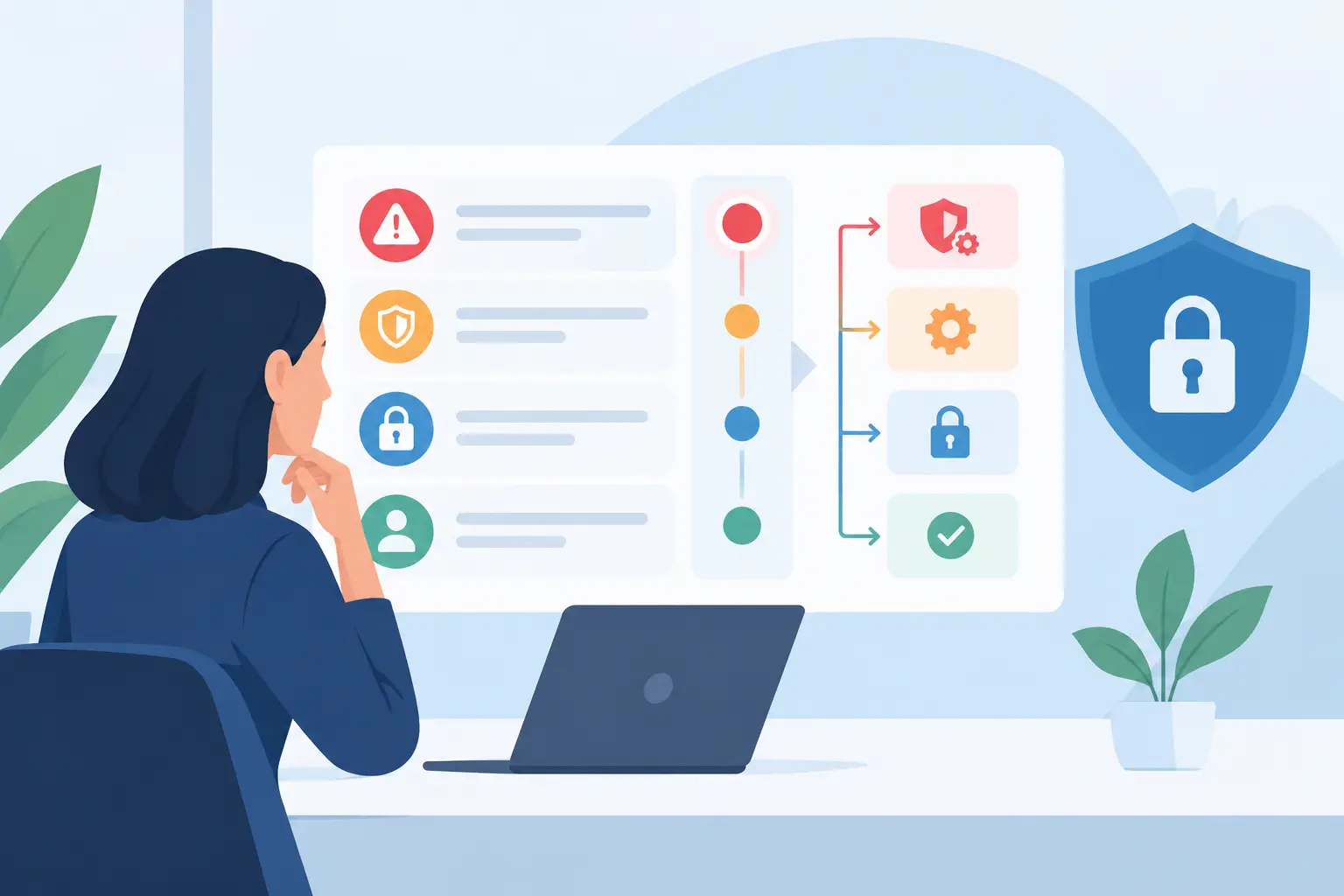
A marketing team may use a public generative AI tool to draft campaign copy while a customer-service team uses an AI assistant to summarize support tickets. Both uses may seem routine. But if the assistant processes customer data, produces inaccurate account guidance, or operates without review, it may create a much more urgent business exposure. AI risk prioritization is the process that makes this distinction clear - so leaders can focus attention where it is needed first.
For many organizations, the immediate challenge is not finding potential AI risks. It is deciding which risks deserve intervention now, which need monitoring, and which can be accepted with appropriate controls. A useful prioritization process turns a long inventory of concerns into clear decisions, accountable owners, and documented next steps.
Why an AI risk inventory is not enough
An inventory answers a basic question: where is AI being used? That is a necessary starting point, but it does not establish whether a use case is appropriate, adequately controlled, or aligned with the organization's risk tolerance.
A single AI system can affect privacy, security, legal obligations, operational continuity, customer trust, and decision quality at the same time. Treating every identified concern as equally urgent creates two problems. Teams either become overwhelmed by a backlog they cannot manage, or they apply broad restrictions that slow useful innovation without addressing the highest-impact exposures.
Effective AI risk prioritization creates proportion. It asks not only whether a risk exists, but what could happen, who could be affected, how likely the outcome is, and whether existing safeguards are sufficient. The result should be a practical order of work, not a theoretical scorecard.
This matters most when AI use expands faster than formal oversight. Employees may adopt tools independently, vendors may add AI features to existing software, and pilots may move into production before governance processes catch up. A repeatable prioritization method gives leaders a way to establish control without requiring a lengthy consulting engagement before taking the first step.
Build priority around business impact and control gaps
A credible assessment should consider several dimensions together. Severity matters, but it is only one part of the decision. A low-probability event involving sensitive customer data may still require immediate attention because the consequence is significant. Conversely, a low-stakes internal writing assistant may be manageable with basic usage guidance and review.
Start with the use case, not the tool name
The same model or vendor can present very different risk depending on how it is used. An AI tool that suggests internal meeting summaries is not equivalent to one that helps determine eligibility, pricing, hiring, access, or customer outcomes.
Document the purpose of the system, the people affected, the data it handles, and whether it informs or makes decisions. Also identify whether its output is public-facing, operationally consequential, or used in a regulated process. This context prevents a generic technology label from driving the assessment.
Assess impact across the right categories
For each use case, consider the plausible impact of a failure or misuse. Privacy and confidentiality concerns rise when personal, financial, health, proprietary, or client information enters an AI workflow. Security exposure rises when systems have access to internal applications, credentials, code, or sensitive documents.
Business impact also includes inaccurate outputs, biased treatment, intellectual-property concerns, contractual commitments, regulatory duties, reputational harm, and disruption to critical operations. The question is not whether every scenario is certain. It is whether the organization could reasonably defend its current controls if the scenario occurred.
Measure likelihood in the real operating environment
Likelihood is not simply a technical estimate. It depends on how people use the system, the quality of available instructions and data, the frequency of use, the degree of automation, and the opportunity for human review.
An AI output that is checked by a qualified employee before it affects a customer has a different risk profile from an automated action that proceeds without meaningful intervention. Usage at scale also matters. A minor error repeated thousands of times can become a material operational issue.
Give weight to control effectiveness
Risk priority should account for safeguards that are actually in place, not policies that exist only on paper. Useful controls may include approved-use rules, access restrictions, data-handling requirements, vendor review, logging, testing, human oversight, incident escalation, and periodic reassessment.
A high-impact use case with mature, tested controls may require ongoing monitoring rather than an immediate halt. A seemingly modest use case with no ownership, unclear data practices, and no review process may deserve faster action. Prioritization is about the remaining exposure after controls, often called residual risk.
Which AI risks usually rise to the top
Priority will depend on your industry, risk tolerance, and legal obligations. Still, certain patterns commonly require prompt governance attention because a failure can affect people, sensitive information, or core operations.
- AI systems that process sensitive, confidential, or regulated data without clear limits on collection, retention, sharing, or vendor access.
- Use cases that influence employment, lending, insurance, health, access, pricing, eligibility, or other consequential decisions about individuals.
- Automated actions that can send communications, approve transactions, change records, execute code, or otherwise affect operations without meaningful human review.
- Public-facing AI experiences that may provide inaccurate information, expose proprietary material, make unsupported claims, or damage customer trust.
- Third-party AI services with unclear security practices, limited contractual protections, or insufficient transparency into how data and models are managed.
These are not automatic reasons to prohibit AI use. They are signals that the organization should verify governance, assign accountable owners, and determine whether stronger safeguards are necessary before expanding use.
Turn AI risk prioritization into an operating process
A priority rating has limited value if nobody knows what happens next. The assessment should lead to a decision: approve the use with defined controls, remediate gaps before expansion, restrict the use case, escalate it for leadership review, or retire it.
For every high-priority item, record the use case, risk rationale, accountable business owner, control owner, required action, due date, and review point. This creates evidence that the organization is exercising oversight rather than merely collecting concerns. It also helps compliance, legal, security, data, and business teams work from the same facts.
The right response should be proportionate. A team using AI to organize internal brainstorming may need approved-tool guidance and training. A system influencing customer eligibility may need documented testing, stronger data controls, human review standards, escalation paths, and senior governance approval. Applying the same process to both can waste effort or leave material risk unmanaged.
Reassess priorities when the use case changes. A pilot can become more sensitive when it receives new data, reaches more users, integrates with another system, or moves from decision support to automation. Vendor updates, new regulations, incidents, and changes in organizational risk appetite can also alter the risk profile.
A structured diagnostic can make this process easier to begin. Alignora's free AI Risk Checkup is designed to help organizations identify AI risk exposures and generate a professional governance report in approximately five minutes, providing a documented baseline for the next conversation and action.
Avoid the two common prioritization mistakes
The first mistake is scoring risk once and treating the result as permanent. AI systems, vendors, data flows, and operating practices change quickly. A regular review cadence, triggered by meaningful changes as well as routine intervals, keeps risk decisions current.
The second is relying on a score without explaining the judgment behind it. Leaders need to understand why an item is high priority, what assumptions were made, and which controls would reduce the exposure. Clear reasoning builds trust and makes it easier to secure resources for remediation.
Good AI governance does not require predicting every possible outcome. It requires knowing which uses deserve the closest attention, making decisions that match the organization's risk tolerance, and retaining evidence that people remain accountable for the results. Start with the use cases already operating across the business, then let the highest residual risks determine where governance work begins.