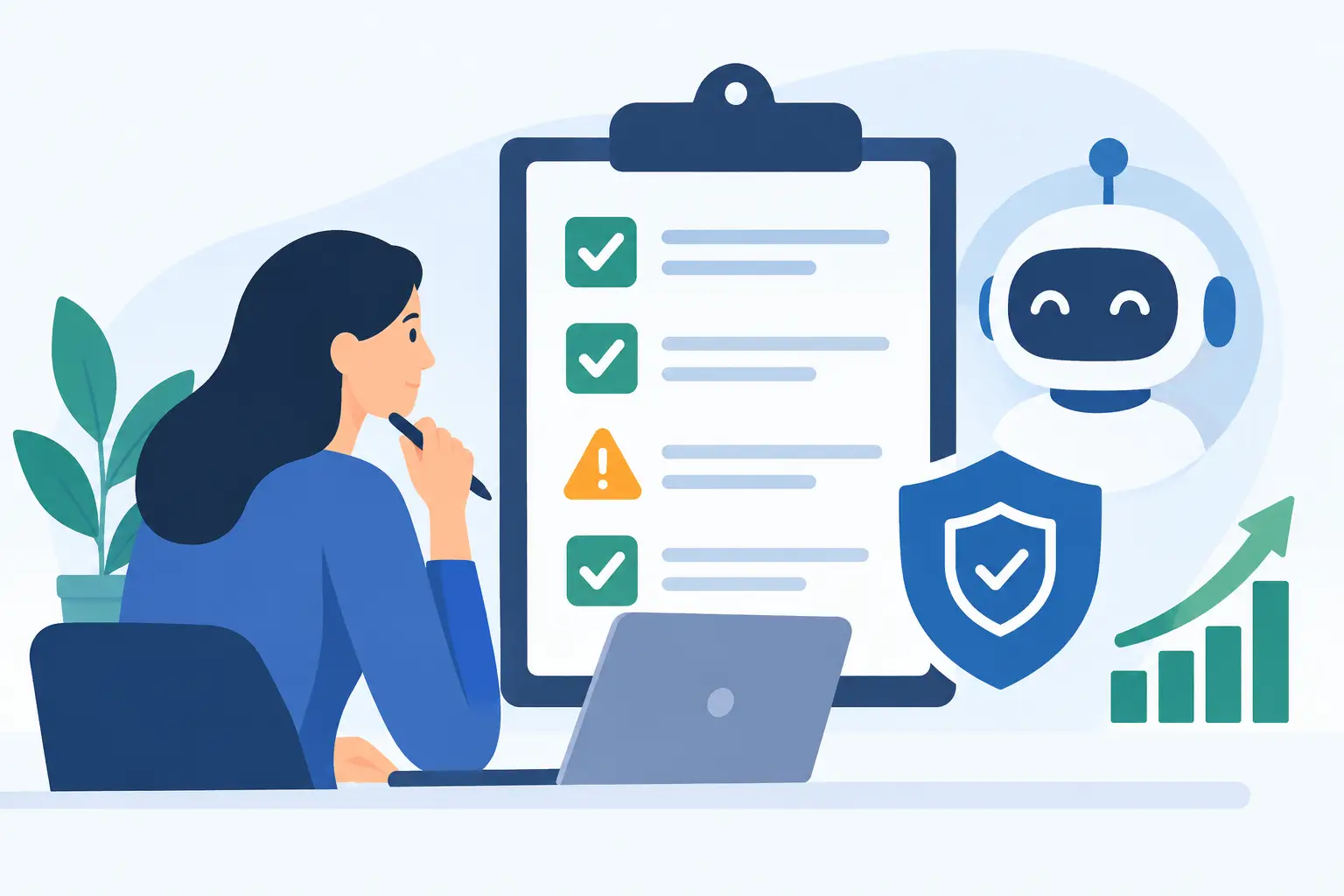
An AI risk questionnaire review should do more than produce a score. It should give decision-makers a clear view of where AI is being used, what could go wrong, who is accountable, and which actions deserve attention first. When AI adoption moves faster than internal oversight, a well-designed review creates the baseline needed to act with confidence.
For many organizations, the problem is not a lack of intent. Leaders want AI use to be secure, fair, transparent, and legally defensible. The challenge is turning those expectations into a practical process that teams can complete, document, and revisit as systems change.
What an AI Risk Questionnaire Review Should Reveal
A useful questionnaire is not a generic compliance exercise. It should connect questions to the real ways your organization uses or plans to use AI. That includes public generative AI tools, internally developed models, vendor platforms with AI features, automated decision systems, and tools that process customer, employee, or confidential data.
The review should establish whether the organization knows where AI is operating and whether controls match the level of exposure. A marketing team using an approved writing assistant presents a different risk profile than an HR system ranking job candidates or a model influencing credit, insurance, healthcare, or security decisions. Treating every use case the same creates unnecessary friction in low-risk work and insufficient oversight in high-impact work.
At a minimum, the review should surface four practical areas: the intended business purpose of the system, the data it receives or generates, the people accountable for its use, and the controls in place before and after deployment. These areas turn abstract AI principles into questions that can be answered, supported, and assigned.
Start With AI Inventory, Not Assumptions
A questionnaire cannot assess what the organization has not identified. Before reviewing controls, establish an inventory of AI use cases. This does not need to begin as a perfect enterprise catalog. A credible first pass can identify the tools, teams, vendors, and workflows most likely to create exposure.
Ask where employees are using AI to create content, analyze data, make recommendations, automate communications, or inform decisions. Include tools purchased by business units, embedded AI features in existing software, and unsanctioned tools employees may use because they are convenient.
The inventory should record enough detail to support risk decisions. For each use case, capture its purpose, system owner, affected individuals, data types, vendor or development source, and whether a human reviews the output before action is taken. If a team cannot name an owner or explain what data enters a system, that finding is valuable. It points to a governance gap that exists before a more technical assessment even begins.
Ask Questions That Lead to Evidence
The quality of an AI risk questionnaire review depends on the quality of its questions. Broad prompts such as “Is the AI system secure?” often invite a confident but unhelpful yes. Stronger questions ask for observable practices and supporting evidence.
For example, rather than asking whether privacy is considered, ask whether the use case has been reviewed for personal, confidential, regulated, or proprietary data. Rather than asking whether a vendor is trustworthy, ask whether the contract, security documentation, data-use terms, and incident procedures have been reviewed by the appropriate owners.
A practical assessment should cover the following areas without becoming a lengthy consulting project:
- Governance and accountability, including named owners and approval paths
- Data privacy and security, including data handling, access, retention, and vendor safeguards
- Model and output risk, including accuracy, bias, harmful content, and human review
- Legal and regulatory exposure, including disclosures, intellectual property, records, and sector-specific obligations
- Operational controls, including monitoring, incident response, training, and periodic reassessment
Evidence does not always mean formal documentation on day one. It can include policy statements, vendor materials, approval records, technical settings, training records, or a documented decision to accept a defined risk. The goal is to distinguish what is known, what is assumed, and what still needs verification.
Review the Answers for Gaps and Dependencies
A completed questionnaire is the beginning of the review, not the end. The most useful findings often appear between answers. A team may state that human oversight exists, for instance, while also indicating that outputs are used at high volume with no quality sampling. Another team may have a strong vendor security review but no clear process for notifying legal or compliance when the tool begins handling new types of data.
Look for dependencies across functions. AI governance rarely belongs to one department alone. Business owners understand the purpose and workflow. Security teams assess technical and vendor exposure. Legal and privacy teams interpret obligations. Compliance and risk teams establish oversight expectations. Data and AI teams can explain model behavior and limitations.
This shared responsibility does not require every stakeholder to approve every low-risk use case. It does require a clear escalation path. Higher-risk systems should receive deeper review when they affect people’s rights, access to opportunities, safety, sensitive data, or material business decisions. Lower-risk productivity tools may need standard guardrails, approved configurations, and employee guidance instead of a full committee process.
Turn Findings Into an Action Plan
The value of the review comes from what happens next. Findings should be organized by priority, owner, and practical next step. A report that only labels issues as high, medium, or low risk can be useful, but it does not tell the organization how to reduce exposure.
Prioritization should consider likelihood, potential impact, and the organization’s ability to address the issue. A missing AI policy may affect many teams and be relatively straightforward to resolve. A high-impact automated decision system may require more time, testing, documentation, and senior oversight. Both deserve attention, but not necessarily in the same sequence.
Good actions are specific. “Improve governance” is too broad. “Assign a business owner for each active AI use case and require documented approval for systems using customer data” gives a team a clear starting point. The same is true for vendor reviews, acceptable-use rules, testing procedures, output monitoring, disclosure practices, and incident escalation.
A free, structured assessment such as Alignora’s AI Risk Checkup can provide that initial baseline quickly, producing a professional governance report that helps leaders move from general concern to defined priorities. It is especially useful when the organization needs a credible starting point before building a more detailed program.
Make the Review a Repeatable Control
AI risk is not static. A low-risk tool can become higher risk when it receives new data, serves a new audience, influences a new decision, or changes vendors or model capabilities. A one-time review can establish direction, but a repeatable process keeps governance aligned with real use.
Set reassessment triggers instead of relying only on an annual schedule. Review a use case when there is a material change in data, purpose, system provider, user population, automation level, or regulatory environment. Incident reports, user complaints, unexpected outputs, and vendor changes should also prompt review.
The right cadence depends on your AI footprint. Organizations experimenting with a small number of approved tools may need a lightweight quarterly check. Organizations deploying AI across customer, workforce, or regulated workflows may need more frequent monitoring and formal reporting. The point is not to create bureaucracy. It is to ensure that growth in AI capability does not outpace accountability.
A Clear Baseline Creates Better Decisions
An AI risk questionnaire review works best when it is treated as an operational decision tool, not a checkbox. It gives executives a concise view of exposure, gives specialists a consistent framework for review, and gives business teams a practical route to use AI responsibly.
Start with the systems already in use, document what is known, and assign ownership for what needs attention. A clear baseline does not slow responsible AI adoption. It gives the organization a stronger basis for deciding where to move faster, where to add controls, and where to pause until the risks are understood.