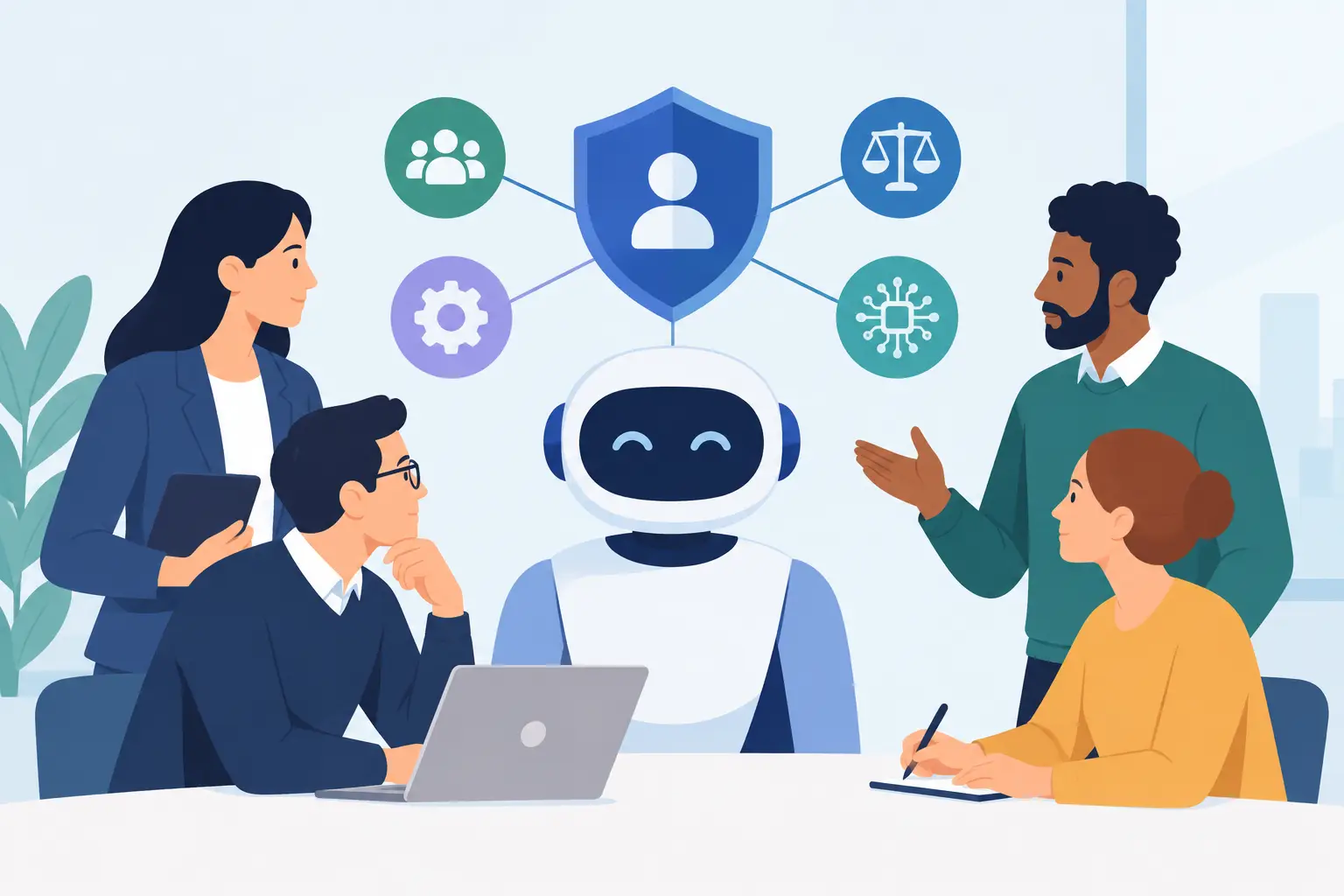
A marketing team adopts a generative AI tool, a developer adds an AI feature to a customer-facing product, and an employee uploads a spreadsheet to a chatbot. Each action can create a different set of privacy, security, legal, operational, and reputational questions. Assigning AI oversight responsibilities is how an organization ensures those questions reach the right person before they become incidents, audit findings, or public problems.
The goal is not to create a large committee that delays every experiment. It is to establish clear ownership for decisions, controls, and escalation. When people know who approves a high-risk use case, who tests a model, who monitors outcomes, and who can stop deployment, responsible AI becomes a business process rather than a policy document.
Why AI oversight needs named owners
AI creates a familiar governance challenge in an unfamiliar form. Organizations already manage vendor risk, data protection, cybersecurity, financial controls, and product quality. AI can touch all of them at once, often through tools that teams can access quickly without a formal procurement process.
Without defined responsibilities, oversight becomes fragmented. Legal may assume security reviewed the tool. Security may assume the business owner validated the data. A product leader may assume the AI vendor is accountable for model behavior. Those assumptions can leave meaningful risks unmanaged.
Named ownership changes the conversation. Instead of asking, "Has anyone reviewed this?" leaders can ask, "Who owns the assessment, what evidence is required, and who has authority to approve or pause this use?" That level of clarity also gives teams confidence to move forward when a use case is acceptable.
Start with the AI use case, not the org chart
Organizations often begin by appointing an AI governance lead and considering the work complete. A lead is useful, but oversight should be designed around the actual ways AI is being used. An internal writing assistant has different risk characteristics from an automated hiring screen, fraud detection system, medical support tool, or customer service agent that can take action on an account.
Create a simple inventory of AI systems, including externally purchased tools, embedded AI features in existing software, internally developed models, and employee-led experimentation. For each use case, document its purpose, users, data inputs, outputs, affected individuals, vendors, and whether it influences a decision about a person.
This inventory helps determine the appropriate level of review. A low-risk internal brainstorming tool may need approved-use guidance and basic data restrictions. A system that processes sensitive data, makes recommendations affecting customers, or operates with a high degree of autonomy may need formal assessment, testing, documented approval, and recurring monitoring.
The key trade-off is proportionality. Treating every AI tool as a major compliance event encourages workarounds. Treating all tools as low risk leaves the organization exposed. Risk tiering allows oversight effort to match the potential impact.
Assign AI oversight responsibilities across functions
There is no single perfect structure. A growth-stage business may centralize several responsibilities under a small leadership group, while a larger enterprise may distribute them across legal, compliance, security, data, product, and internal audit. What matters is that the organization distinguishes accountability from support.
Executive sponsor: accountable for direction and resources
A senior executive should own the organization’s AI governance direction. This person does not need to approve every tool, but they should ensure that AI oversight has authority, funding, and visibility. They are responsible for resolving conflicts when business speed, risk tolerance, and control requirements pull in different directions.
The executive sponsor should receive regular reporting on material AI use cases, open risks, incidents, policy exceptions, and remediation progress. This gives AI governance a clear path to leadership when a decision exceeds a team’s authority.
AI governance lead: coordinates the operating model
The AI governance lead turns policy into an operating process. They maintain the AI inventory, define assessment criteria, coordinate reviews, track approvals and conditions, and make sure requirements remain aligned with business practices and changing expectations.
This role should not become a bottleneck. Its purpose is to make the route for responsible adoption visible and repeatable. For example, the governance lead can establish which risk tier requires legal review, security validation, human oversight design, model testing, or executive approval.
Business owner: owns the purpose and outcomes
Every AI use case needs a business owner. This is the leader who can explain why the system is needed, what decision or workflow it supports, what benefit is expected, and what harm could result if it performs poorly.
The business owner is also responsible for ensuring people use the system as approved. If a tool was assessed for drafting internal communications, that approval should not quietly become permission to generate customer notices or evaluate employees. Changes in purpose, data, user population, or automation level should trigger a reassessment.
Security, privacy, and legal: assess specialized risks
Security teams evaluate access controls, vendor security practices, data flows, identity management, logging, and incident response considerations. Privacy teams examine whether personal information is necessary, lawfully handled, retained appropriately, and exposed to unacceptable secondary use. Legal teams address contractual terms, intellectual property, disclosure obligations, consumer protection, employment concerns, and sector-specific requirements.
These functions should provide defined review criteria, not simply a final yes-or-no opinion. Clear criteria let teams prepare the right evidence early and reduce late-stage surprises.
Data, technical, and product teams: validate performance and controls
Technical owners are responsible for how the AI system behaves in practice. Their work can include evaluating data quality, testing accuracy or task performance, checking for harmful outputs, documenting known limitations, setting access permissions, and establishing monitoring.
For systems that affect people or make consequential recommendations, teams should also define meaningful human oversight. A human reviewer who is expected to rubber-stamp an AI output is not an effective control. The reviewer needs enough context, authority, time, training, and a clear way to override or escalate questionable results.
Document decision rights before an issue occurs
Responsibility is incomplete without decision rights. Teams need to know who can approve a use case, who can approve an exception, who can accept residual risk, and who can suspend or retire a system.
A short responsibility matrix can make this operational. It should identify the use case owner, required reviewers, final approver, control owner, monitoring owner, and escalation contact. It should also state the evidence needed for approval, such as a risk assessment, vendor documentation, data-flow review, test results, user instructions, and incident response plan.
Avoid assigning accountability to a group without identifying a final decision-maker. Committees can provide valuable challenge and expertise, but a committee name is not an owner. When accountability is shared too broadly, difficult decisions are often deferred.
Make oversight continuous, not a one-time approval
AI systems change after launch. Vendors release new model versions, employees find new uses, connected data sources expand, and output quality can shift over time. A use case approved six months ago may no longer match its original risk assessment.
Set review triggers that require the business owner to return to the governance process. Common triggers include a new data category, a new vendor or model, a new customer-facing function, a materially different decision use, a significant incident, or a change in applicable rules. Scheduled reviews are also useful for systems with elevated impact.
Monitoring should be practical. Track the indicators that matter for the use case: error rates, override rates, complaints, harmful-output reports, access anomalies, model changes, or policy exceptions. The right metrics depend on the system. A customer support assistant and an AI-assisted credit decision process should not be measured the same way.
Build evidence leaders can use
Good oversight produces records that support decisions. That includes the risk assessment, assigned owners, approvals, limitations, test evidence, training requirements, monitoring results, and remediation actions. Documentation is not paperwork for its own sake. It helps leaders demonstrate that AI risks were identified, evaluated, and actively managed.
For organizations building their first governance foundation, a structured assessment can reveal where responsibility is unclear before AI adoption expands further. Alignora’s free AI Risk Checkup is designed to provide a fast baseline and a professional report that helps teams identify governance priorities and start the internal conversation with evidence.
The strongest AI governance programs are not defined by the number of policies they publish. They are defined by whether a person facing a new AI use case knows what to do next, who to involve, and when to stop and ask for help. Clear responsibility turns that answer into an everyday capability.