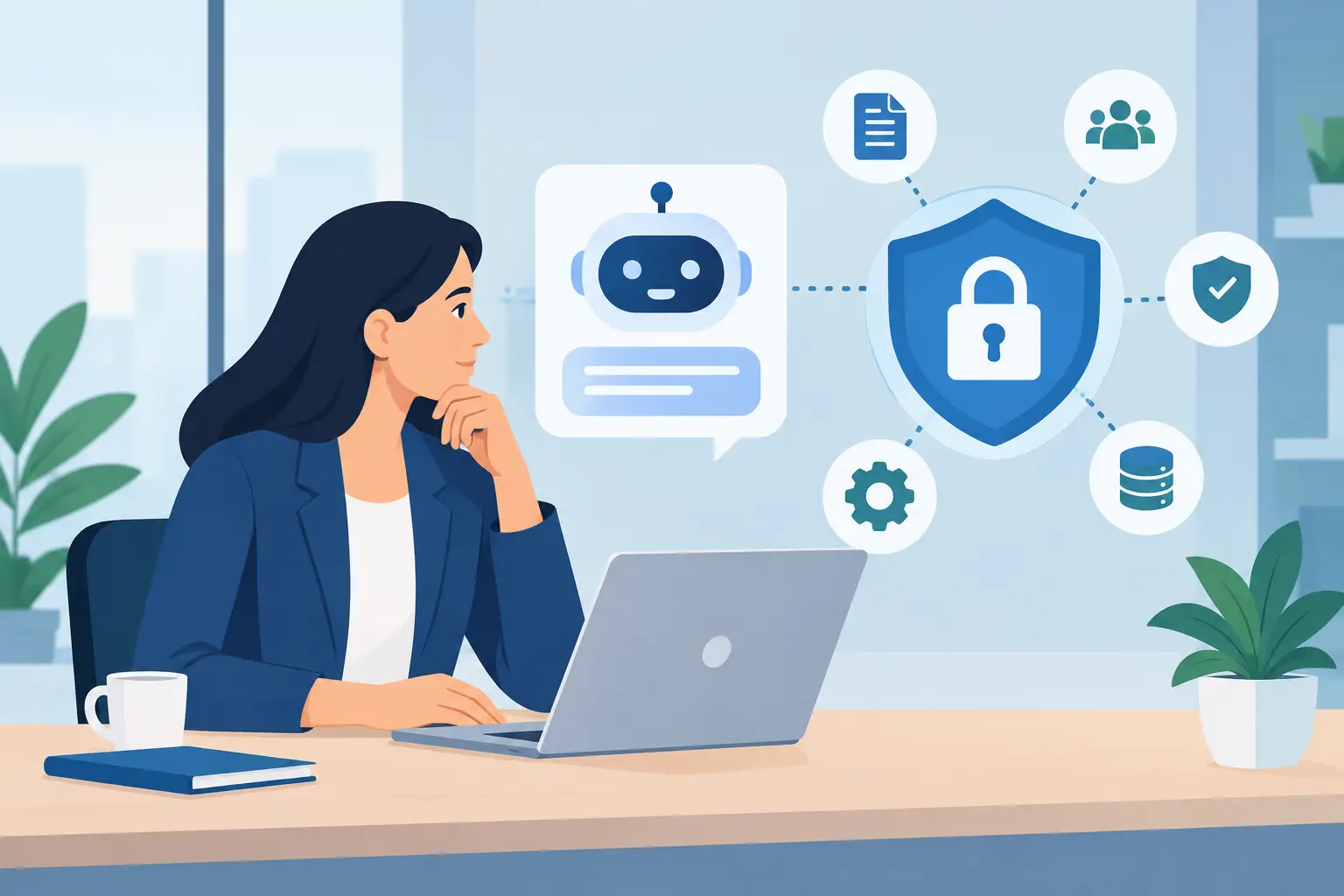
A chatbot can move from a useful employee experiment to a company-wide data exposure faster than most teams expect. To evaluate chatbot privacy risks effectively, look beyond the chat window and examine what enters the system, where it goes, who can access it, and how long it remains available.
This is not a reason to stop using chatbots. It is a reason to put a clear decision process around them before sensitive customer, employee, financial, or proprietary information becomes part of routine prompts.
Start with the chatbot's real purpose
Privacy assessment begins with a practical question: what job is this chatbot expected to do? A public-facing support assistant, an internal HR assistant, and a coding copilot may all be called chatbots, but they create very different data flows and risk levels.
Document the use case in plain language. Identify the users, the systems the chatbot connects to, the decisions it can influence, and the information it may receive. If the chatbot only answers questions from approved public documentation, its privacy exposure may be limited. If it retrieves account records, summarizes employee files, or processes healthcare-related communications, the assessment needs to be much more rigorous.
Purpose also sets boundaries. A chatbot approved to help employees locate policies should not quietly become a tool for evaluating performance, drafting disciplinary decisions, or collecting personal disclosures. Scope creep is often where manageable privacy risk becomes an unmanaged governance issue.
Map the data before evaluating the tool
The most useful privacy review is a data-flow review. Teams should be able to explain what data is collected at each point, how it is transmitted, where it is processed, and what happens after a conversation ends.
Start with the obvious inputs: prompts, uploaded files, conversation histories, names, email addresses, and account identifiers. Then consider less visible data, such as IP addresses, device information, usage logs, metadata, feedback submissions, and records pulled from connected systems.
Classify the information by sensitivity. Personal data, confidential business information, credentials, payment details, health information, legal material, source code, and customer records should not receive the same treatment as public marketing copy. A chatbot may be technically capable of accepting any of it. That does not mean it should be authorized to do so.
Ask whether the chatbot actually needs each category of information to perform its purpose. Data minimization is both a privacy principle and an operational control. Reducing unnecessary inputs reduces the potential impact of a mistake, breach, unauthorized reuse, or overly broad employee adoption.
Pay attention to connected systems
A chatbot connected to a CRM, document repository, ticketing platform, or HR system can be more useful than a standalone tool. It can also inherit the privacy and access risks of every connected environment.
Review what the integration can read, write, search, export, or retain. Confirm whether the chatbot receives only the information needed for a response or whether it can access broad datasets by default. Permissions should follow existing role-based access rules, not bypass them through a conversational interface.
A simple test helps: could an employee obtain information through the chatbot that they would not be permitted to view directly in the source system? If the answer is yes, access controls need attention before deployment expands.
Review vendor data practices, not just product features
A polished interface and strong model performance do not answer the central privacy questions. Your team needs clear documentation of the provider's data practices and contractual commitments.
Determine whether prompts, outputs, or uploaded files are retained. Ask how long logs are stored, whether customers can configure retention periods, and whether deleted content is removed from active systems and backups according to defined processes. Retention should match the business purpose, legal requirements, and your internal records policy.
Also determine whether customer content may be used to train or improve the provider's models. The answer may differ by product tier, account setting, deployment model, or feature. A consumer-grade account used by an employee may have materially different protections than an enterprise service procured through your organization.
Review where data is processed and stored, particularly if your organization operates across jurisdictions or handles regulated data. Examine subprocessors, security certifications, incident notification commitments, and the provider's approach to government or third-party data requests. Legal and procurement teams should be able to identify the applicable contract terms rather than relying on assumptions from a sales conversation.
Assess access, authentication, and conversation visibility
Privacy risk is not limited to the AI provider. Internal access is equally important. A secure chatbot can still create exposure if conversations are visible to the wrong administrators, shared across teams without purpose, or retained in unmanaged employee accounts.
Set expectations for identity management from the beginning. Enterprise authentication, multi-factor authentication, role-based permissions, and timely offboarding reduce the chance that former employees or unauthorized users retain access. Shared logins should be avoided because they undermine accountability and make investigations more difficult.
Clarify who can view chat logs, download transcripts, alter settings, connect data sources, and approve new use cases. Administrative access should be limited, reviewed periodically, and logged. Where conversation monitoring is necessary for security, quality, or compliance, employees and users should understand that monitoring occurs and why.
For public-facing chatbots, consider what a user might disclose without being prompted. Clear notices can discourage users from entering account numbers, passwords, health details, or other sensitive information. The chatbot should be designed to avoid requesting unnecessary personal data and to route sensitive requests to an appropriate secure channel.
Test for privacy failures in realistic scenarios
Policies matter, but testing reveals how a chatbot behaves under pressure. Before broad rollout, use controlled test cases that reflect realistic behavior: an employee pastes a confidential contract, a customer shares an account number, a user asks the chatbot to reveal another person's information, or a prompt tries to override instructions and expose connected data.
Evaluate whether the chatbot refuses inappropriate requests, limits access correctly, and provides safe alternatives. Test whether outputs can accidentally combine data from separate users, whether uploaded documents remain accessible after permissions change, and whether deletion requests work as expected.
This work should involve more than one owner. Privacy, security, legal, IT, data leadership, and the business team using the chatbot will see different risks. The goal is not to create a slow approval committee for every minor change. It is to establish an escalation path for high-risk use cases and a repeatable review process for routine ones.
Put human oversight around consequential uses
A chatbot can help draft, summarize, search, and route work. It should not be treated as the final authority where privacy, employment, financial, legal, or customer outcomes are at stake.
Define when a trained person must review an output before action is taken. For example, a chatbot may prepare a customer-service response, but a human should handle identity verification, sensitive account changes, complaints involving personal data, or decisions that could materially affect an individual.
Human oversight also includes a way to report problems. Employees need a clear route to flag an inappropriate response, suspected data exposure, inaccurate retrieval, or a use case that falls outside approved boundaries. Those reports should feed into a documented process for investigation, remediation, and improvement.
Make privacy controls operational, not theoretical
The strongest chatbot privacy program is one people can follow during a busy workday. Publish practical rules about approved tools, prohibited data types, authorized integrations, and when to seek help. Training should use examples relevant to each team's work instead of generic warnings that are easy to forget.
Keep an inventory of chatbot tools and use cases, including who owns each one, what data it handles, which vendor supports it, and when it was last reviewed. Reassess when the tool gains new capabilities, connects to new data sources, changes its terms, or moves from a limited pilot to wider adoption.
A structured assessment creates a defensible baseline for those decisions. Alignora's free AI Risk Checkup can help organizations identify governance gaps and produce a professional report that gives leaders a clear starting point for action.
The right next step is rarely a perfect policy document. It is a focused review of the chatbot already in use, followed by clear controls that employees can apply before the next sensitive prompt is entered.