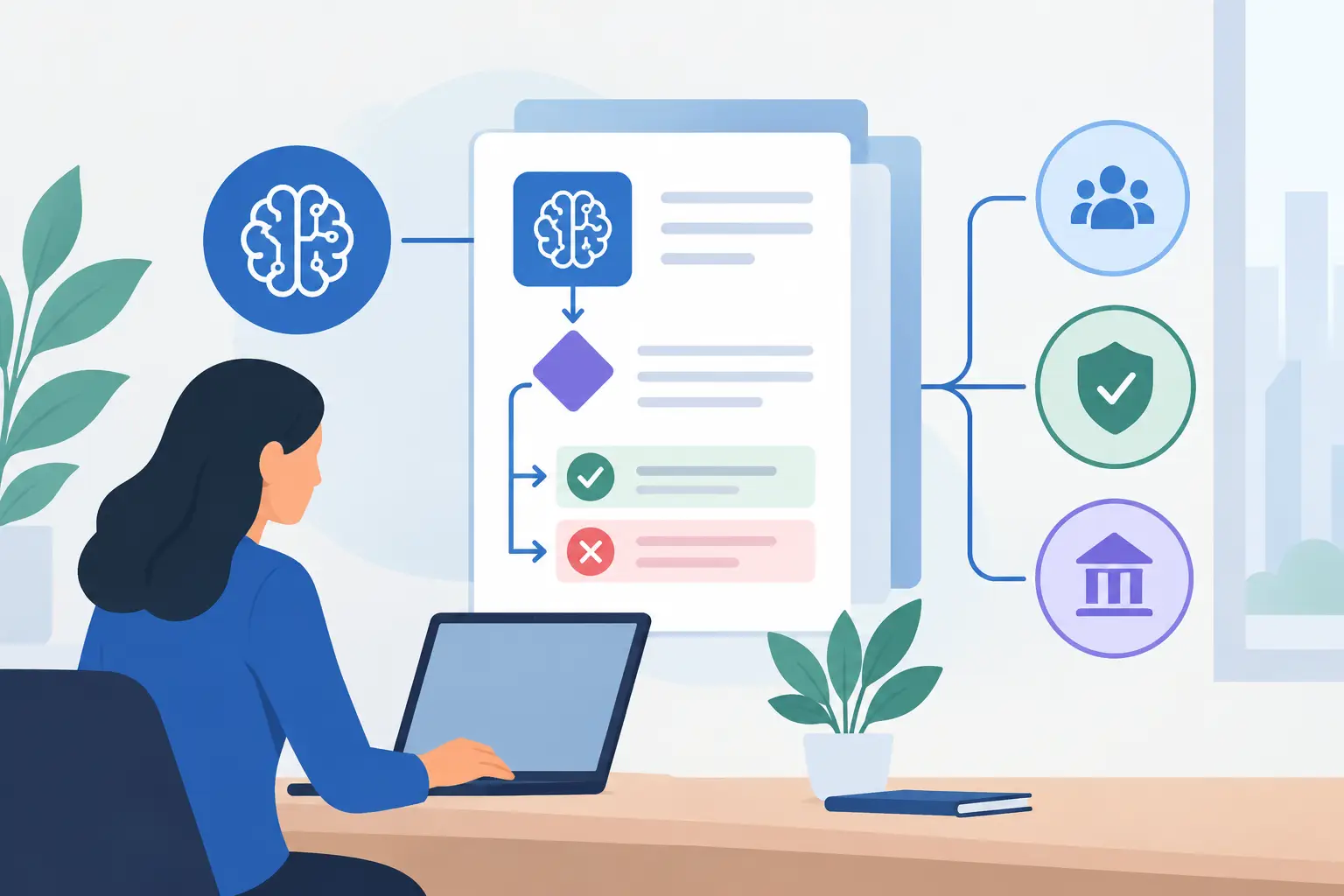
A team approves a generative AI tool for customer support, then six months later a customer asks how their data was handled. Legal asks who approved the tool. Security asks what controls were reviewed. Operations asks whether human review was required. If no one can answer quickly, the problem is not only the AI tool. It is the missing decision record.
Knowing how to document AI decisions gives an organization a practical way to show that AI use was considered, assigned, reviewed, and monitored. It turns governance from an informal conversation into evidence that leaders, auditors, regulators, customers, and internal teams can understand.
Document AI decisions as they happen
The best time to document an AI decision is when it is made, not after a concern appears. Reconstructing a decision months later usually creates gaps: people leave, vendor documentation changes, and the reasons behind trade-offs become unclear.
A useful record does not need to read like a legal brief. It should explain what was decided, why it was decided, who had authority, what risks were considered, and what conditions must remain true for the decision to stand. The goal is clear accountability, not paperwork for its own sake.
This applies to more than buying an AI product. Organizations should capture decisions throughout the AI lifecycle, including whether to use AI for a business process, whether a use case is prohibited, whether a model can move from testing to production, whether a vendor meets requirements, and whether an existing system should be paused or retired.
Start with a defined decision scope
Before creating a record, name the decision precisely. “Approved AI” is too broad to be useful. “Approved a generative AI assistant for drafting internal marketing content, with no customer data permitted” provides a usable boundary.
The scope should identify the business purpose, the team using the system, the people affected, and the type of output produced. A recruiting screening tool, for example, requires a different level of scrutiny than an internal tool that summarizes meeting notes. The difference is not just technical. It concerns impact, privacy, fairness, legal exposure, and the consequences of an inaccurate output.
A clear scope also prevents approval creep. If a tool was approved for internal content drafting, that does not automatically authorize its use for customer communications, employment decisions, financial recommendations, or sensitive-data analysis. Each material expansion should trigger a new review or an update to the original record.
Capture the evidence behind the decision
A decision log should be short enough that teams will maintain it and detailed enough that another person can understand the judgment. The following information is typically worth recording:
- The decision statement, date, decision owner, and approvers
- The intended use case, users, affected individuals, and business objective
- The AI system or vendor involved, including model version where relevant
- The data involved, especially personal, confidential, regulated, or proprietary information
- Key risks identified and the controls selected to reduce them
- Conditions for approval, review dates, monitoring expectations, and escalation triggers
The quality of the rationale matters more than the length. Instead of writing “security reviewed,” document what security evaluated and the outcome. For example: “Approved for internal use after confirmation that uploaded prompts are not used to train the provider’s public model under the organization’s selected account settings.”
Likewise, avoid vague statements such as “bias risk is low.” A stronger record might explain that the system is limited to drafting assistance, outputs are reviewed by trained employees, and the tool cannot make or recommend decisions about hiring, lending, eligibility, or other high-impact outcomes.
Separate the decision from the supporting artifacts
A decision record should point to evidence, but it should not attempt to contain every artifact. Vendor terms, security questionnaires, privacy assessments, testing results, model cards, contract provisions, and meeting notes can all support the record without making it unreadable.
Think of the decision log as the front page of a file. A reader should see the outcome and reasoning first, then be able to locate the supporting materials if deeper review is needed. This approach is especially useful when legal, security, procurement, and business teams contribute different forms of evidence.
Centralization matters. Records scattered across email threads, chat messages, shared drives, and project tickets are difficult to find and even harder to defend. Use one governed location with access controls, clear ownership, version history, and a process for updating decisions when facts change.
Assign ownership without creating bottlenecks
Every AI decision needs an accountable owner. That person is not necessarily the technical lead or the executive sponsor. The owner should be able to confirm that conditions are being met, coordinate updates, and escalate concerns.
For lower-risk use cases, a business owner may be able to document the decision using a standard intake and approval workflow. Higher-risk uses may require legal, privacy, security, data governance, human resources, or compliance review. The right level of review depends on the context.
A useful principle is to match governance effort to potential impact. An internal productivity tool with no sensitive data may need a streamlined record. An AI system that influences people’s access to jobs, credit, housing, health services, education, or essential opportunities requires deeper documentation, testing, and ongoing oversight.
Fast approval is still possible when the process is structured. Define which decisions can be handled through standard controls, which require specialized review, and which uses are not permitted. Teams move more confidently when they know the path rather than guessing who needs to sign off.
Record trade-offs, not just approvals
Most meaningful AI decisions involve trade-offs. A vendor may offer valuable capabilities but limit explainability. A model may reduce manual workload while increasing the need for human quality checks. A business team may want broad access, while security requires restricted data handling.
Documenting those trade-offs demonstrates that the organization did not treat AI as risk-free or reject it automatically. It shows why a particular path was reasonable based on the information available at the time.
For example, a team may choose not to connect an AI assistant to a customer database during the initial rollout. The record should explain that the organization is prioritizing a lower-risk pilot while it evaluates access controls, data minimization, output accuracy, and user training. That rationale creates a clear basis for a later expansion decision.
Make review dates part of the decision
AI decisions expire faster than many traditional technology decisions. Models change, vendors change terms, regulations evolve, data flows expand, and employees find new ways to use tools. A decision that was appropriate at launch may no longer be appropriate after a major product update or a new integration.
Each record should include a review date and events that require earlier reassessment. Common triggers include a change in intended use, use of new data categories, a significant vendor or model update, an incident or complaint, poor testing results, or a new legal requirement.
Periodic review is also a practical way to identify shadow AI use. When business leaders know there is a defined process for documenting and assessing tools, teams have a clearer route to request approval instead of adopting unreviewed services on their own.
Use a repeatable template, then improve it
Consistency makes AI governance easier to operate and easier to explain. A standard decision template helps teams provide the same core information while allowing deeper review where the risk warrants it. It also makes patterns visible across the organization, such as repeated reliance on one vendor, recurring data risks, or teams that need better guidance.
An AI risk assessment can provide the starting baseline for this work. Alignora’s structured AI Risk Checkup helps organizations identify exposures and produce a professional governance report that can inform decision priorities and documentation practices.
The record itself is not proof that a decision was perfect. It is proof that the organization established accountability, considered relevant risks, selected controls, and created a path to revisit the decision when conditions change. That is what makes documentation useful: it gives responsible AI oversight a clear place to begin and a reliable way to continue.