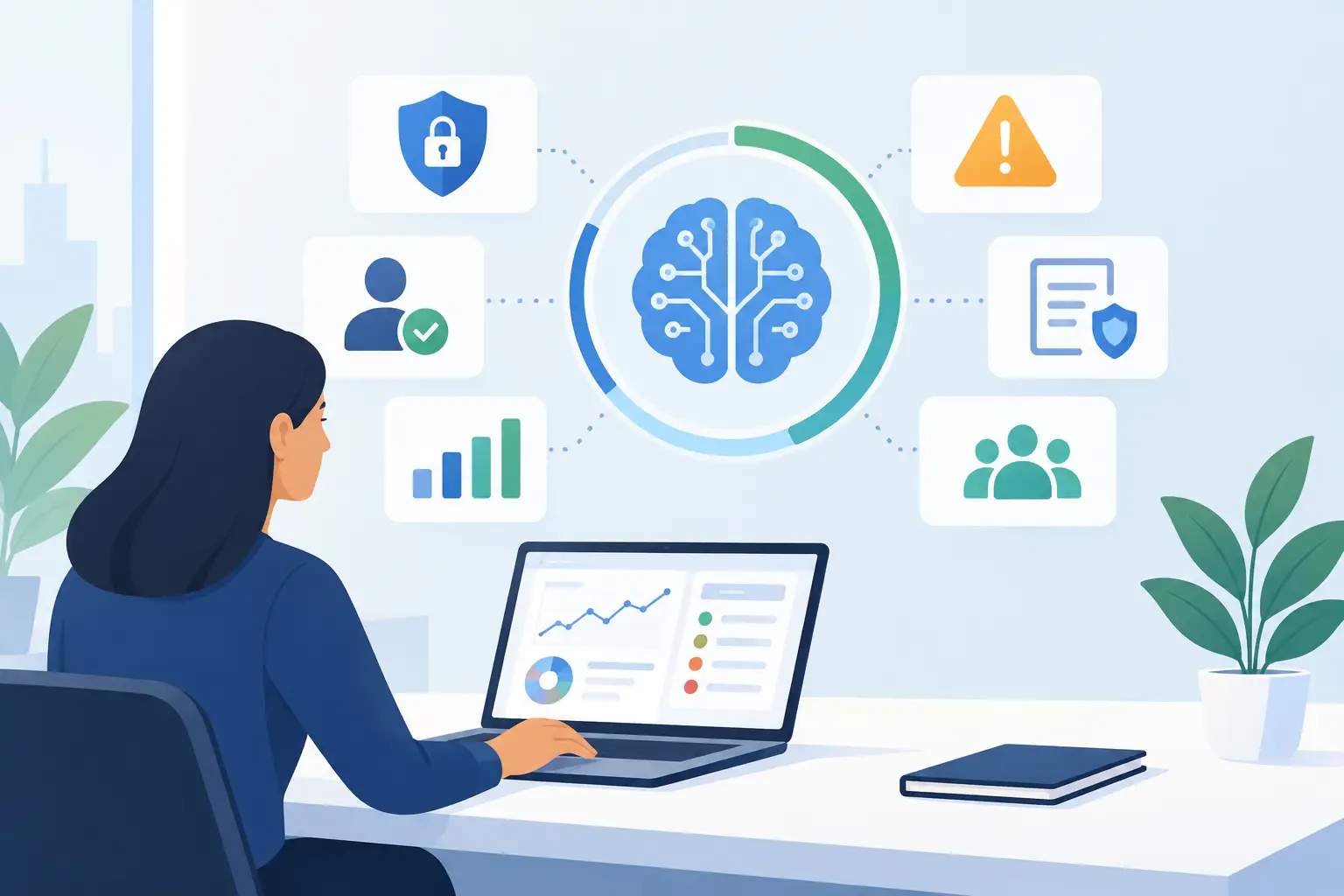
A model can perform well in a pilot and still create material risk six months later. Customer behavior changes, source data shifts, vendors update underlying systems, and employees find new ways to use AI. Model monitoring gives leadership a way to see those changes before they become security incidents, unfair outcomes, poor decisions, or difficult questions from regulators and customers.
For organizations using generative AI, predictive models, or automated decision support, monitoring is not simply a technical exercise. It is an ongoing governance process that connects system performance to business impact, human accountability, and documented oversight.
What Model Monitoring Actually Means
Model monitoring is the regular review of an AI system after deployment to determine whether it continues to perform as intended and remains appropriate for its use case. It should assess more than accuracy. A model can produce statistically acceptable results while creating privacy concerns, treating similar groups inconsistently, generating unsupported claims, or being used outside its approved purpose.
The right approach depends on the system. A fraud detection model may require close tracking of false positives and missed fraud. A hiring or lending model may require careful review for disparate impact, explainability, and legal obligations. An internal generative AI assistant may call for testing of sensitive-data exposure, hallucinations, harmful outputs, and employee reliance on its responses.
The common question is straightforward: is this AI system still delivering an acceptable outcome within the boundaries the organization set? Monitoring provides evidence to answer it.
Why Performance Metrics Are Not Enough
Technical teams often begin with model drift. Drift occurs when the real-world data reaching a model no longer resembles the data used to build or validate it. A change in customer behavior, market conditions, product mix, or data collection practices can reduce reliability without triggering an obvious system failure.
Drift matters, but it is only one signal. Effective model monitoring also considers whether inputs are complete and valid, whether outputs remain useful, and whether people are making appropriate decisions with those outputs. A model may be stable from a statistical perspective while its operational context has changed significantly.
Consider an AI tool that summarizes customer support interactions. Its summaries may remain fluent and factually similar to earlier results. Yet a new workflow could cause staff to paste account details or health information into prompts, creating a data-handling exposure that accuracy metrics will never reveal. Governance monitoring needs to identify that shift.
This is why business, compliance, security, legal, data, and operational stakeholders all have a role. No single dashboard can establish that a deployed AI system remains responsible.
Build Model Monitoring Around Real Risks
Start with the model's approved purpose. Document what it is intended to do, who uses it, which decisions it informs, what data it can access, and where human judgment is required. This baseline makes monitoring meaningful. Without it, teams collect measurements without knowing what conditions should trigger concern.
Next, define the risk signals that matter for the specific system. These usually fall into several connected areas:
- Performance signals, such as accuracy, error rates, latency, failed requests, and unavailable source data.
- Data and security signals, including unusual inputs, sensitive information exposure, access changes, and third-party data handling.
- Outcome signals, such as complaints, reversal rates, inconsistent results, harmful content, or evidence of biased treatment.
- Governance signals, including unapproved use cases, missing reviews, outdated documentation, and exceptions that have not been resolved.
Not every organization needs to track every measure continuously. The appropriate level of monitoring depends on the potential impact of the AI use case. A low-risk internal drafting tool may need periodic sampling and usage controls. A system that influences employment, financial, health, safety, or customer eligibility decisions needs tighter thresholds, clearer escalation paths, and more frequent review.
The goal is proportional oversight. Over-monitoring a low-impact tool can waste attention and encourage teams to bypass governance. Under-monitoring a high-impact system can leave leadership unable to show that foreseeable risks were addressed.
Establish thresholds before problems occur
A monitoring plan should state what constitutes an acceptable range and what happens when a measure falls outside it. For example, a defined increase in false positives may require a technical review. Evidence of sensitive data in prompts may require immediate access restrictions and a security assessment. A pattern of unsupported AI-generated recommendations may require changes to the workflow, prompts, training, or human approval process.
Predefined thresholds prevent a common failure: treating every signal as interesting but none as actionable. They also make decision-making more consistent when business pressure is high.
Create a Review Cadence People Can Follow
Monitoring works when it becomes part of normal operations rather than a report generated after an incident. Assign an accountable owner for each system, but do not assume that owner must solve every issue. The owner should coordinate review, retain evidence, and ensure that the right functions are involved when concerns arise.
A practical cadence may include automated operational alerts, monthly checks of key metrics and access activity, and quarterly governance reviews. Material changes should trigger an additional review outside the regular schedule. These changes can include new data sources, a new model version, expanded user access, a vendor update, a new geographic market, or a new decision use case.
Generative AI deserves particular attention because vendor models and features can change quickly. A tool approved for internal brainstorming may become connected to enterprise data, gain agent capabilities, or be used to communicate externally. Each change can alter the risk profile, even if the organization did not change the original policy.
Keep reviews concise and evidence-based. Teams should be able to answer: What changed? What did we observe? Does the issue affect people, security, compliance, or operations? Who decided what to do? When will the fix or follow-up review occur?
That record matters. It supports internal accountability and gives leaders a clearer position if customers, auditors, partners, or regulators ask how AI use is governed.
Treat Human Oversight as a Control, Not a Slogan
Human oversight is often described broadly, but it only reduces risk when it is designed into the process. Asking employees to "use judgment" is not enough if they lack the information, authority, time, or training to question an AI output.
For higher-impact use cases, define when a person must review output, what they should check, and when they must escalate. A reviewer may need to verify source information, assess whether a recommendation fits the individual case, or reject an output that conflicts with policy. The process should also make it possible to override the AI without creating unnecessary friction or penalties.
Monitoring can reveal whether this control is working. If employees accept nearly every output, review may be performative. If they regularly override recommendations, the model may be poorly calibrated, the workflow may be unclear, or the use case may no longer be suitable for automation.
Turn Monitoring Results Into Governance Evidence
The value of model monitoring is not the number of charts produced. It is the organization's ability to make and document informed decisions. When a concern appears, the response may be a retraining effort, a technical adjustment, a policy update, additional employee guidance, a vendor discussion, or a decision to pause the system. Continuing use can also be reasonable when evidence shows the risk is understood and adequately controlled.
Maintain a simple record of the system's purpose, assessment results, monitoring activity, incidents, material changes, decisions, and open actions. This does not need to become a burdensome compliance project. It needs to be reliable enough that decision-makers can see the current state of each meaningful AI use case.
Organizations that are still building this foundation can begin with a structured risk assessment. Alignora's free AI Risk Checkup can help establish an initial view of governance exposures and create a professional report for internal discussion.
The most useful monitoring program is one your organization will actually maintain. Start with the AI systems that have the greatest potential to affect customers, employees, sensitive data, or significant business decisions. Give each system a clear owner, define what must be watched, and make sure every meaningful signal has a path to action. That is how AI oversight becomes a working business practice rather than a policy that sits untouched.